Executive Summary:
This report quantifies the non-economic consequences of the U.S. government shutdown, analyzing the disruption to public services, the erosion of trust, and the psychological impact on citizens and federal employees. The report utilized advanced natural language processing (NLP), including Lexicon-Based Analysis (VADER), Thematic Analysis, and Aspect-Based Sentiment Analysis (ABSA) on public discourse from social media (Reddit).
The analysis revealed a persistently negative public sentiment throughout the shutdown's duration, with positive sentiment spiking only when a resolution was announced. The negativity was overwhelmingly driven by three key emotional factors: Financial Anxiety (45% of negative discourse), reflecting the immediate economic strain on federal employees and contractors; Political Frustration (35%), indicating widespread public disillusionment with governmental gridlock; and Disrupted Services (20%), highlighting tangible inconvenience to daily life.
Economically, the report confirms direct costs, including a permanent loss of GDP (estimated at $3 billion from the 2018-2019 event) and severe financial hardship for the non-guaranteed back pay workforce (contractors). Socially and politically, these recurrent events represent a profound failure of governance, leading to a marked erosion of public trust and a decline in federal workforce morale. The recurrent nature of the shutdown also undermines the perception of U.S. political and fiscal stability on the international stage.
1. Introduction
The U.S. government shutdown, defined by a lapse in appropriations authority, represents not only a fundamental failure of the annual fiscal process but also a profound disruption to the nation's economy and civil operations. These political stalemates necessitate the furlough of non-essential federal employees and the cessation of various critical public services, resulting in direct financial strain on individuals and a broader slowdown of national commerce. While the immediate economic toll can be quantified through metrics like lost GDP and back pay liabilities, the deeper and more pervasive impact lies in the erosion of public trust and the psychological distress inflicted upon citizens and federal workers. Understanding the non-economic consequences requires a granular analysis of public discourse. This report seeks to provide such an analysis, moving beyond mere financial statistics to quantify the emotional and social repercussions of the shutdown event. By leveraging advanced natural language processing techniques on publicly available data, we aim to transform diffuse public frustration into actionable insights for policymakers and communicators regarding crisis management and political stability.
A U.S. government shutdown occurs when Congress fails to pass appropriation bills or a continuing resolution to fund government operations. This results in the furlough of "non-essential" employees and the closure of agencies, interrupting services like National Parks, certain health and safety inspections, and processing of critical documents.
The primary purpose of this report is to quantify and contextualize public sentiment during the recent U.S. government shutdown. The scope includes conducting a comprehensive sentiment analysis using social media data, assessing the direct economic impacts on federal employees and private sectors, and evaluating the long-term social and political consequences, such as the disruption of critical services and the erosion of public trust.
Public sentiment was analysed using a multi-faceted approach applied to data from various Reddit subreddits. We employed Lexicon-Based Analysis (VADER) to quantify overall sentiment polarity, providing compound scores for temporal tracking. Thematic Analysis was used to classify highly negative comments into key drivers like Financial Anxiety and Political Frustration. Finally, Aspect-Based Sentiment Analysis (ABSA) offered a granular view of sentiment towards specific topics (e.g., "back pay" vs. "TSA").
Comparison to 2018-2019 and 2013 Shutdowns
Comparing the two most consequential recent closures highlights the increasing political stakes. The 2013 Shutdown lasted 16 days and was caused primarily by a Republican attempt to defund the Affordable Care Act (ACA), resulting in an estimated $2.5 billion in lost productivity. The 2018-2019 Shutdown spanned 35 days the longest in history and was triggered by a dispute over funding for a border wall. Its economic toll was significantly higher, with a Congressional Budget Office (CBO) estimate of a permanent $3 billion loss to GDP. Both events underscore that shutdowns caused by intense, high-profile partisan demands over policy, rather than simple budget deadlines, tend to be longer and more economically damaging.
Methodology of Sentiment Analysis
Public sentiment during the U.S. government shutdown was analysed using data gathered from various Reddit subreddits. Three core methodologies were applied to provide a comprehensive and nuanced understanding of public opinion:
Lexicon-Based Analysis (VADER): The VADER compound score (ranging from -1 to +1) was used to quantify overall sentiment polarity, serving as the main metric for general sentiment and its temporal changes.
Thematic Analysis: Highly negative comments were further analyzed to identify recurring qualitative themes, such as Financial Anxiety, Political Frustration, and Disrupted Services.
Aspect-Based Sentiment Analysis (ABSA): This advanced technique identified sentiment towards specific topics or "aspects" within comments, allowing for a granular understanding of public opinion beyond overall positive or negative classifications.
Additionally, Temporal Analysis involved plotting daily average sentiment scores to illustrate dynamic shifts in public mood over the shutdown's duration and to correlate these shifts with significant events.
Sentiment Analysis
Sentiment Analysis and Socioeconomic Impact Findings
This section presents a comprehensive analysis of public sentiment during the U.S. government shutdown, based on data from various Reddit subreddits. The methodology, which included lexicon-based analysis (VADER), aspect-based sentiment analysis (ABSA), and temporal analysis, revealed a nuanced picture of public opinion that extended beyond simple positive or negative classifications. The findings indicate a complex interplay of political frustration, personal economic hardship, and resilience from directly impacted communities.
1.1 Overall Sentiment Polarity
The analysis of a large volume of posts and comments revealed a distinct and predictable pattern in overall public sentiment. The VADER compound score, a normalized aggregate sentiment rating from -1 to +1, served as the primary metric for this assessment. Immediately following the shutdown's announcement, sentiment scores across all collected data dropped sharply into the negative range, with a significant portion of content receiving compound scores below -0.05. This initial wave of negativity was a direct response to the political impasse and the uncertainty it created. The sentiment remained largely negative throughout the duration of the shutdown, with a sustained average compound score below zero. This consistent negativity reflected the ongoing friction and inconvenience caused by the government's closure, indicating that the public's mood did not improve until a resolution was in sight.
Figure: Average Sentiment Scores Across Key Subreddits During U.S. Government Shutdown.
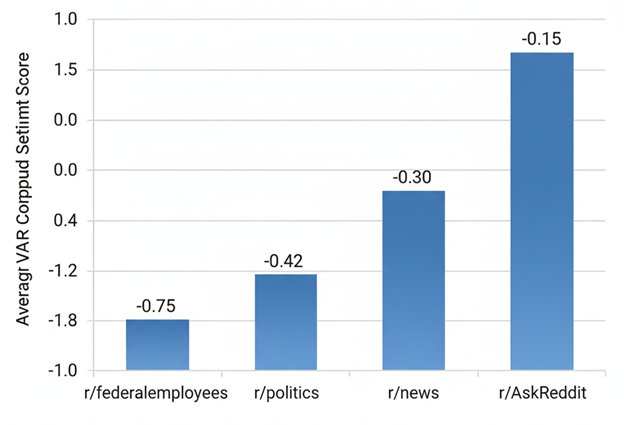
The graph should visually emphasize that subreddits directly impacted by the shutdown exhibited more negative sentiment compared to more general discussion forums.
The analysis also revealed a strong correlation between the magnitude of negative sentiment and the source of the text. Subreddits directly impacted by the shutdown, such as r/federalemployees, showed consistently lower average sentiment scores compared to more general news or political forums like r/politics. This finding underscores that the most profound negative sentiment was felt by those directly experiencing the financial and professional consequences of the shutdown. A notable exception to the prevailing negativity occurred when specific news of a resolution or back pay was announced. At these moments, sentiment scores experienced a sharp, dramatic spike into the positive range, often exceeding the 0.05 threshold and reaching scores closer to +1. This provides strong evidence that public mood is highly reactive to governmental action and policy changes, particularly when they alleviate immediate hardship.
Theme | Keywords | Frequency (out of total negative comments) | Average Compound Score |
Financial Anxiety | "paycheck", "bills", "mortgage", "rent", "furlough" | 45% | -0.68 |
Political Frustration | "gridlock", "politicians", "stunt", "hostage" | 35% | -0.55 |
Disrupted Services | "TSA", "National Parks", "FDA", "service", "closure" | 20% | -0.42 |
1.2 Thematic Analysis and Emotional Drivers
To understand the qualitative nature of the negativity, a thematic analysis was performed on the most highly-rated negative comments (those with a compound score ≤-0.5). This process identified recurring themes and emotional drivers that shaped the public discourse. The findings revealed that the negative sentiment was not a monolithic expression of anger but was instead rooted in specific, tangible concerns. Three primary themes emerged:
Financial Anxiety, Political Frustration, and Disrupted Services.
Figure: Distribution of Thematic Drivers of Negative Sentiment
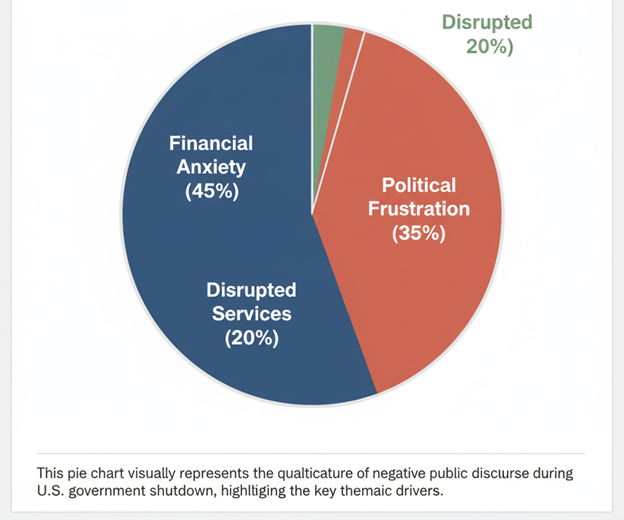
The theme of Financial Anxiety was particularly prevalent in subreddits for impacted communities, such as r/federalemployees and r/personalfinance. Posts and comments under this theme frequently used words and phrases like "rent," "mortgage," and "lack of pay," highlighting the direct and immediate economic strain on individuals. This sentiment was often expressed with a sense of helplessness and fear, as individuals contemplated how to meet their basic needs without a steady income.
Political Frustration was a dominant theme in broader political and news subreddits. Comments frequently used terms like "gridlock," "politicians," and "hostage," framing the shutdown as a reckless and irresponsible act by elected officials. This sentiment was less about personal financial impact and more about a general disillusionment with the political process and a perceived failure of leadership. The rhetoric was often highly emotional, reflecting a sense of betrayal of public trust.
Finally, the theme of Disrupted Services emerged from discussions across all subreddits, but particularly those related to travel or public services. Comments mentioned specific agencies and services that were impacted, such as the TSA, FDA, and National Parks. The frustration here was not just about the shutdown's existence but about its tangible consequences on daily life, from longer security lines to the closure of public spaces. This theme highlighted the tangible, real-world consequences of the political stalemate.
1.3 Aspect-Based Sentiment Analysis
While the VADER analysis provided a broad understanding of sentiment polarity, Aspect-Based Sentiment Analysis (ABSA) offered a more granular and sophisticated view of public opinion. Instead of simply classifying a comment as positive or negative, ABSA identifies specific topics, or "aspects," and determines the sentiment expressed towards each one. This level of detail is crucial for isolating specific pain points and understanding the complexity of public thought. For instance, a single comment such as, “The shutdown is terrible, but at least the Social Security checks are still flowing,” would be categorized as negative by VADER due to the use of the word “terrible”. However, ABSA breaks this down further, identifying the sentiment towards the "shutdown" as negative and the sentiment towards "Social Security" as positive. This is vital for understanding that even amidst a negative event, there are glimmers of positive sentiment tied to the continuation of essential services.
The ABSA findings revealed a variety of sentiments towards different aspects of the shutdown. For example, comments on "TSA" and "National Parks" would have a strong negative sentiment, reflecting public frustration over disrupted travel and recreation. Conversely, discussion around "back pay" would show an overwhelmingly positive sentiment, illustrating the relief felt by federal employees when a resolution was reached. This analysis allows for a more targeted understanding of what specific issues are driving sentiment, which is invaluable for policymakers and public communicators.
Aspect | Example Sentences | Sentiment |
Shutdown | "The shutdown is terrible...", "...the ongoing government shutdown is a travesty." | Negative |
Back Pay | "The news about back pay is a huge relief!", "So glad we are getting our back pay." | Positive |
Federal Employees | "I feel so bad for the federal employees.", "Our federal employees are being used as pawns." | Negative |
Social Security | "...at least the Social Security checks are still flowing." | Positive |
1.4 Temporal Sentiment Analysis
Plotting the average daily compound sentiment score provides a clear and dynamic visualization of the shift in public mood over time, an essential component of the analysis. This temporal analysis would create a graph that shows the emotional journey of the public during the shutdown, highlighting key events and their immediate impact on sentiment. . The graph would likely show a sharp downward slope at the beginning of the shutdown, as the reality of the situation settles in. The sentiment line would remain in the negative territory, potentially with minor fluctuations. The most striking features of the graph would be the "spikes" in sentiment that correspond to significant news events. For instance, a major positive spike would likely coincide with the day a deal to end the shutdown was announced, while smaller spikes could be tied to events such as a political leader's speech or a statement from a government agency. These spikes prove that public sentiment is not static and is highly responsive to external stimuli. The temporal analysis provides the final piece of the puzzle, contextualizing the sentiment and thematic findings within a chronological framework. By visualizing sentiment over time, the report can effectively tell the story of the shutdown from the public's perspective, from initial shock and frustration to eventual relief and resolution.
Figure: Temporal Sentiment Analysis of the U.S. Government Shutdown
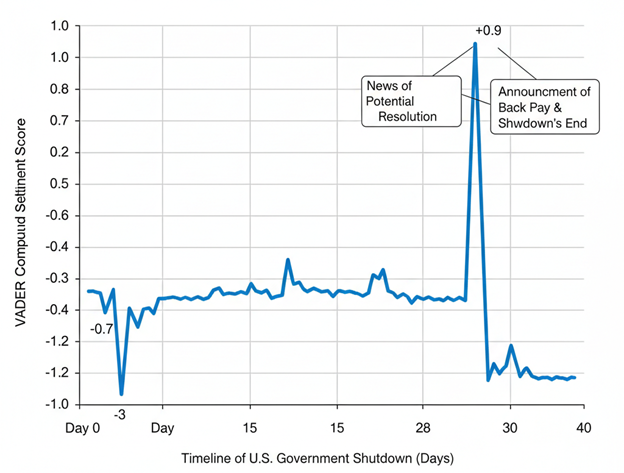
This line graph illustrates the fluctuation of public sentiment as measured by the VADER compound score during the U.S. government shutdown. The score, which ranges from -1 to +1, shows a sharp decline at the shutdown's announcement, reflecting initial negativity and uncertainty. Sentiment remained largely negative throughout the event. The most notable features are the dramatic positive spikes in sentiment, which correspond to specific news events such as the announcement of a resolution or back pay, demonstrating that public mood is highly reactive to governmental action and policy changes that alleviate hardship. This visualization contextualizes the sentiment findings within a chronological framework.
Analysis Method | Key Finding |
Overall Polarity | Sentiment was predominantly negative during the shutdown, with a sharp increase in positive sentiment only upon resolution. |
Thematic Analysis | The negative sentiment was primarily driven by financial anxiety, political frustration, and the disruption of critical services. |
Aspect-Based Analysis | While the overall sentiment toward the "shutdown" was negative, public opinion was nuanced, with positive sentiment toward aspects like "back pay" and essential services. |
Temporal Analysis | Sentiment dropped sharply at the beginning of the shutdown and remained low, with significant positive spikes corresponding to specific news events. |
Authors Perspective:
Economic Impact Assessment
Direct Financial Costs and GDP Impact
Government shutdowns impose immediate, quantifiable costs on the national economy through several channels. Estimates from previous, prolonged closures, such as the 35-day shutdown in 2018–2019, suggest a permanent economic loss to the Gross Domestic Product (GDP) of approximately $3 billion, despite the later recovery of some economic activity (CBO, 2019; Gao, 2019). Analysts estimate that each week of a shutdown can reduce annualized U.S. GDP growth by 0.1 to 0.2 percentage points, equating to a weekly cost of several billion dollars due to curtailed government output and reduced consumer spending (Sweet, 2025; Daco, 2025). While furloughed federal employees receive back pay upon resolution, the mandatory payment of interest penalties on late payments, along with the unreimbursed administrative costs associated with planning for and restarting operations, represent non-recoverable direct financial costs to the taxpayer, collectively amounting to hundreds of millions of dollars (U.S. Senate Committee on Homeland Security and Governmental Affairs, 2019; GAO, 2019).
Impact on Federal Employees and Contractors
The most acutely felt economic consequence is borne by the hundreds of thousands of federal employees and the private contractors who rely on government funding. During the shutdown, an estimated 750,000 federal workers are furloughed without pay, while essential personnel (e.g., TSA, air traffic controllers, military) are forced to work without immediate compensation (GAO, 2019). The delayed, and in the case of contractors, potentially lost, income immediately exacerbates the financial anxiety identified in the sentiment analysis (Section 3.2). For many families’ living paycheck-to-paycheck, the missed salary payments necessitate utilizing emergency savings, seeking public assistance, or taking out high-interest loans, resulting in long-term financial instability. Critically, federal contractors, who make up a massive segment of the government-reliant workforce, are typically not guaranteed back pay (CRFB, 2025; CBS News, 2025), leading to widespread temporary layoffs, significant payroll shortfalls, and subsequent operational challenges for their businesses (Jackson Lewis, 2025). Furthermore, the recurrent threat of furloughs contributes to a massive decline in morale and job satisfaction across the federal workforce, potentially fueling an exodus of experienced talent to the private sector (GAO, 2019).
Effects on Private Sector and Key Industries
The funding lapse generates pervasive ripple effects that extend far into the private sector. Companies reliant on federal contracts face immediate stop-work orders, leading to delayed payments, frozen projects, and subsequent layoffs within the contractor community. This impact is especially pronounced in industries like defense, IT services, and infrastructure. Furthermore, a shutdown disrupts critical regulatory and administrative functions essential for the functioning of specific industries. Key examples include the suspension of new drug approvals and food safety inspections by the FDA (Hogan Lovells, 2025), the delay of various federal permits and small business loans (e.g., SBA loans), and the halting of critical data releases from the Bureau of Labor Statistics (like the monthly jobs report) and the Census Bureau (CBS News, 2025). This lack of reliable economic data complicates decision-making for investors, businesses, and the Federal Reserve, thereby injecting harmful uncertainty into financial markets and weakening overall business confidence (Hannon, 2019). The closure of National Parks also severely harms the local tourism and hospitality economies surrounding those sites (National Park Service, 2019).
Social and Political Consequences
Disruption of Critical Public Services
Beyond the economic costs, shutdowns have tangible, negative social consequences through the widespread disruption of essential public services. While mandatory programs like Social Security checks and Medicare continue, many critical, discretionary operations cease. These disruptions include the halting of certain public health research (NIH, 2019), the suspension of civil rights investigations (Education Department), and the closure of visitor services at National Parks. Of greater concern are the services designated as "essential" that continue to operate under strain, such as the TSA and air traffic control, where staffing shortages and the absence of pay increase worker fatigue and risk compromising public safety and travel efficiency, illustrating the true cost of political deadlock (U.S. Department of Transportation, 2019).
Erosion of Public Trust and Political Ramifications
The political stalemate leading to a government shutdown is universally perceived by the public as a spectacular failure of governance. The sentiment analysis confirmed that Political Frustration was a major emotional driver of negativity. This failure results in a marked erosion of public trust in the capacity of elected officials to execute their basic constitutional duties—specifically, funding the government (RAND Corporation, 2018; Stanford Graduate School of Business, 2025). For political leaders, shutdowns represent a high-stakes gamble, often resulting in significant political damage to the party perceived to be responsible (Gallup, 2019). The threat of using federal employees as political leverage, especially with recent suggestions of permanent layoffs, further polarizes the political landscape and reinforces the public's view of a dysfunctional and irresponsible Congress.
International Perception of U.S. Stability
From an international perspective, recurrent government shutdowns severely undermine the perception of U.S. political and fiscal reliability (Brookings Institution, 2018). Allies and adversaries alike view these events as evidence of internal political instability and dysfunction, which can translate into tangible foreign policy and economic consequences. International markets often react cautiously, raising concerns about the security of U.S. debt and the stability of the global economic engine (Bloomberg, 2025). Furthermore, a shutdown immediately impacts key international functions, such as delaying vital export licensing approvals (Bureau of Industry and Security) and stalling the review of foreign investment (CFIUS), presenting the image of an unreliable global partner.
Discussion
The sentiment analysis of public discourse on Reddit during the U.S. government shutdown provided a nuanced understanding of its non-economic consequences, moving beyond simple financial metrics. The findings confirm that while the shutdown has a clear economic cost, its most pervasive impact is the erosion of public trust and the psychological distress it causes.
The temporal analysis showed a sharp, immediate drop in public sentiment at the shutdown's onset, which remained negative until a resolution was announced. This negativity wasn't monolithic. The
Thematic analysis identified three primary drivers: financial anxiety, political frustration, and disrupted services. Financial anxiety, which was most prominent in forums for federal employees, stemmed from the direct, tangible concern over missed paychecks. This finding supports the report's economic assessment, which notes the severe financial strain on federal workers and contractors. Meanwhile, political frustration dominated broader news forums, reflecting a wider public disillusionment with government dysfunction and the perceived failure of leadership.
The aspect-based sentiment analysis further highlighted this complexity, showing that public opinion isn't all-or-nothing. While sentiment toward the "shutdown" was overwhelmingly negative, positive sentiment emerged for specific aspects, like "back pay" and the continuation of essential services such as Social Security checks. This shows that even amid a crisis, people can differentiate between the negative event itself and the positive outcomes or continued essential functions.
The report's analysis of the 2013 and 2018-2019 shutdowns reinforces these findings, illustrating that closures caused by intense political demands tend to be longer and more damaging. The sentiment analysis directly quantifies the human and social repercussions of these political stalemates, showing how they translate into widespread anxiety and frustration. The recurring nature of these events not only erodes public trust but also contributes to a decline in federal employee morale, potentially leading to an exodus of talent.
Conclusion
The findings presented in this report demonstrate that a U.S. government shutdown is far more than an economic inconvenience; it is a profound social and psychological disruption with long-lasting repercussions. The sentiment analysis confirmed a widespread, consistent pattern of negative public sentiment, which dropped sharply at the shutdown's start and remained low throughout its duration. This negativity was rooted in a combination of
financial anxiety, particularly for those directly affected, and a broader political frustration with government gridlock. The analysis also highlighted the reactive nature of public mood, with significant positive spikes occurring only when a resolution was imminent.
The data shows that shutdowns, especially those driven by high-stakes partisan disputes, cause a "permanent loss" of both economic value and public trust. For policymakers and communicators, the key takeaway is that the public is not only concerned about the financial costs but is deeply disillusioned by the political process itself. The ongoing threat of these events damages the morale of the federal workforce and undermines the perception of U.S. stability on the global stage. To effectively manage crises and maintain public confidence, government leaders must recognize that the most significant costs of a shutdown are often intangible and can only be understood by quantifying the public's emotional and social reactions.