1. Introduction
The economic relationship between the United States and India has evolved into one of the most significant bilateral trade partnerships of the 21st century. In 2023, the United States remained India’s largest trading partner, with bilateral goods and services trade surpassing USD 191 billion, reflecting deepening interdependence between the two economies [1]. Historically, trade between the two nations has been characterized by complementarities: the U.S. as a leading importer of Indian pharmaceuticals, textiles, and information technology services, and India as a growing market for U.S. machinery, aircraft, and agricultural products [2].
Despite this trajectory, tensions over tariffs and market access have periodically disrupted relations. Recent U.S. tariff measures targeting Indian exports mark a critical juncture, raising questions about their impact on India’s growth trajectory and global trade positioning. This article seeks to analyse these developments in a balanced manner, exploring sectoral effects, geopolitical realignments, and strategic policy choices.
2. Understanding the Tariff Measures
In late August 2025, the United States intensified trade barriers against India, implementing an additional 25 % levy on top of an earlier 25 % “reciprocal” tariff bringing total duties to as much as 50 % on numerous Indian exports [3]. This escalation followed failed negotiations and was explicitly linked to India’s increasing imports of Russian oil, which Washington interpreted as indirect support for Moscow amid the Ukraine conflict [3]. The targeted sectors include labor-intensive and high-employment categories such as textiles and apparel, gems and jewelry, shrimp and seafood, leather goods, furniture, chemicals, and engineering products sectors that collectively account for over 55 % of India’s approximately USD 87 billion in annual merchandise exports to the U.S. [4]. Analysts warn that American buyers have already suspended new orders, and export volumes could decline by 20–30 % beginning September [5].
Importantly, sectors such as pharmaceuticals and electronic goods, including semiconductors, currently remain exempt from these elevated tariffs, offering temporary relief to segments critical to India’s export profile [5]. In response, the Indian government has announced measures to cushion the shock: exporters are being offered financial incentives, including subsidies and concessional loans, while also being encouraged to diversify export markets toward ASEAN, Latin America, Africa, and the European Union [4]. Simultaneously, India is exploring avenues through the World Trade Organization (WTO) and bilateral frameworks to challenge or mitigate the impact of these tariffs [4].
3. Economic Impact on India’s Growth Story
India’s trade dynamics in mid-2025 reflect both increased exposure to U.S. markets and evolving shifts within global partnerships. In July, India’s merchandise trade deficit surged to an eight-month high of US$27.35 billion, driven largely by sharply rising imports (US$64.59 billion) against modest export gains (US$37.24 billion) [7]. Notably, Indian shipments to the U.S. climbed 21.6% year-on-year in the April–July period, indicating a pre-emptive surge in exports ahead of looming 50% tariffs [7]. From a BRICS perspective, India’s trade deficit with member countries has tripled in recent years from approximately US$68 billion in 2020 to US$209 billion in 2024 as imports from BRICS, especially in energy, electronics, and machinery, rose sharply [8]. This rising imbalance adds complexity to India’s trade calculus amid U.S. tariff pressures. According to economic commentator Professor. Mohsin Raza Khan, Department of Economics, O.P Jindal Global University, retaliatory or escalation in tariffs could trigger a vicious cycle of rising import costs, domestic inflation, and a widening trade deficit [9]. He cautions that such policies risk destabilizing both macroeconomic performance and currency value, while directly affecting jobs in key labour-intensive sectors. At the sectoral level, the newly imposed tariffs are expected to disproportionately affect textiles, gems and jewellery, seafood (especially shrimp), leather goods, furniture, and chemicals. These sectors are among the most labour-intensive and export-dependent, raising substantial risks to employment and export volumes [7, 10]. Although exports continued rising ahead of tariffs, analysts anticipate a 20–30% contraction in export volumes in the near term, potentially reducing sectoral growth and reversing pre-existing gains [10].
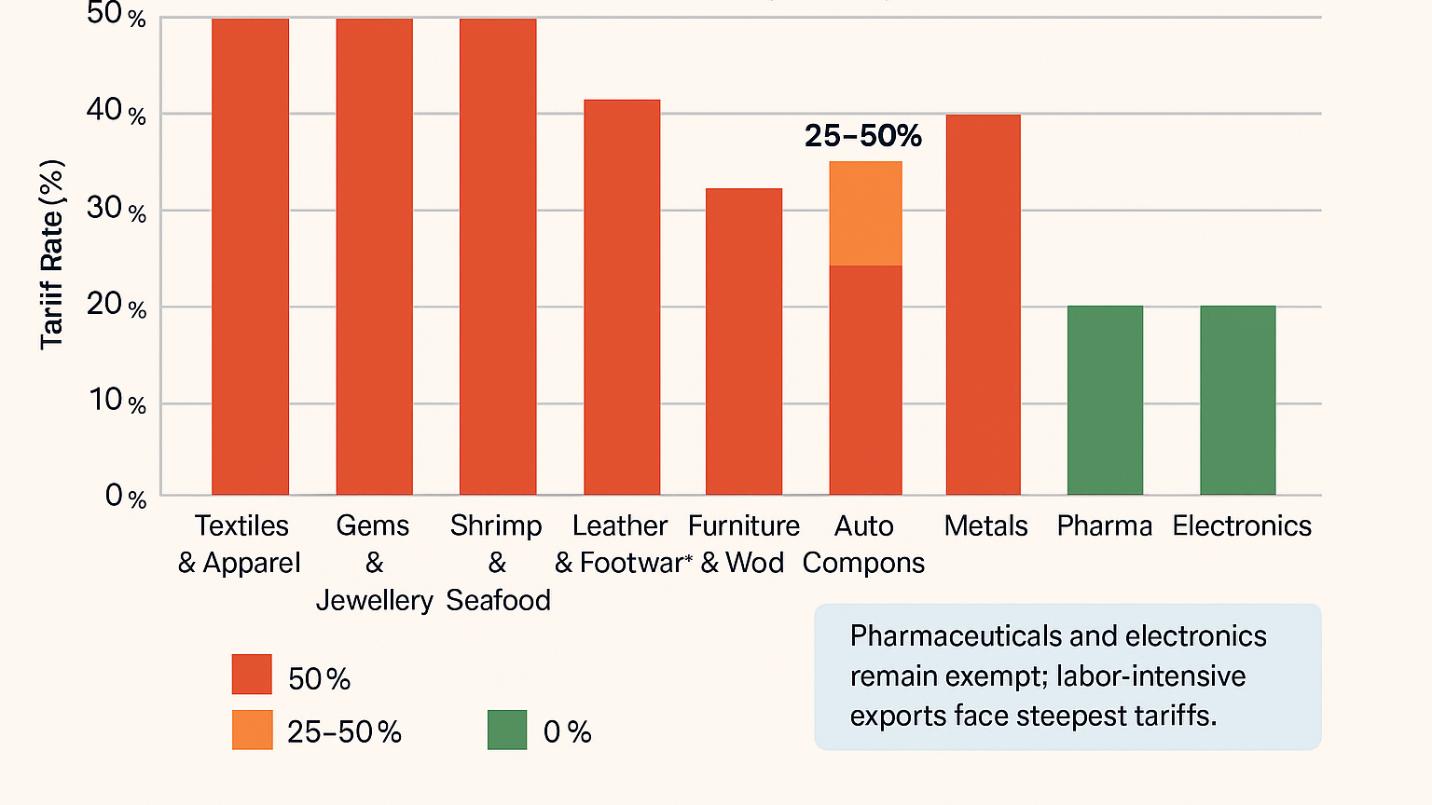
Collectively, the trade deficit spike, growing BRICS imbalance, and sector-specific vulnerabilities underscore the multi-dimensional challenges India confronts under the current trade regime. As shown in Table 1 and Figure 1, the steepest tariff burdens fall on labor-intensive sectors such as textiles, gems and jewellery, and seafood, which collectively account for a significant share of India’s export basket. Exporters in these categories have already reported order cancellations, with projections of a 20–30% decline in volumes over the coming quarters. By contrast, high-value sectors such as pharmaceuticals and electronics are currently exempt, offering temporary relief to India’s foreign trade profile. This uneven impact highlights the dual nature of U.S. tariff measures: targeting India’s labor-intensive strengths while sparing strategic supply chain segments like generics and semiconductors.
Table 1: Sector Exposure of Indian Exports to U.S. Tariffs (2025)
Sector | Annual Export Value to U.S. (USD bn) | Tariff Rate Applied | Estimated Impact | Key Notes |
Textiles & Apparel | 20.0 | 50% | High (20–30% drop in orders expected) | Labor-intensive, highly vulnerable to cost escalation. |
Gems & Jewellery | 9.0 | 50% | High | Diamond polishing and jewelry exports face global competitiveness loss. |
Shrimp & Seafood | 7.0 | 50% | High | U.S. is India’s largest shrimp buyer; exporters already report suspended orders. |
Leather & Footwear | 5.0 | 50% | Moderate–High | Export growth likely to stagnate; SME-heavy sector. |
Furniture & Wood Products | 4.0 | 50% | Moderate | Niche market but directly tariff-hit. |
Chemicals & Engineering Goods | 12.0 | 50% | Moderate | Includes plastics, organic chemicals, industrial machinery. |
Auto Components | 8.0 | 25–50% (25% on passenger vehicle parts, 50% on larger vehicle parts) | Moderate–High | Supply chain integration risk; targeted within auto sector. |
Metals (Steel/Aluminum) | 6.0 | 50% | High | Competitiveness loss; overlap with existing U.S. metal tariffs. |
Pharmaceuticals | 8.5 | Exempt | None (short-term) | Generics spared, ensuring stability of pharma exports. |
Electronics (incl. smartphones, semiconductors) | 7.5 | Exempt | None (short-term) | Critical export segment protected. |
Figure 1: Sector-wise tariff impacts on Indian exports to the U.S. (2025).
4. The U.S. Perspective
The recent surge in U.S. tariff policy is emblematic of a broader shift toward protectionism, driven by domestic political imperatives such as bolstering manufacturing employment and appealing to voters in key labour-intensive regions [11]. These tariffs are strategically utilized as tools of economic leverage, aiming to rebalance trade deficits and reshore production to strengthen national security, especially in critical sectors such as defence and semiconductors [12]. However, frequent tariff adjustments—subject to unilateral executive decisions have significantly undermined business confidence and long-term investment planning [13]. Prominent economist Jeffrey Sachs has strongly criticized this approach, characterizing it as “bound to fail” and warning that protectionism risks isolating the U.S. from the global economy and eroding its competitiveness [14]. He cautions that affected countries are increasingly diversifying away from the U.S., while internal volatility discourages foreign partners from sustained engagement [14].
The cumulative effect is dual-edged: while tariffs may offer short-term protection to domestic industries, they contribute to global uncertainty and can hinder the U.S.'s broader strategic objectives, notably in containing the rise of emerging markets through cooperative mechanisms. The U.S.’s tilt toward abrupt protectionism may ultimately undermine its capacity for strategic economic engagement and alignment in a multipolar world.
5. Global Geopolitical Realignments
The imposition of steep U.S. tariffs has accelerated India’s strategic recalibration amid a shifting multipolar order. New Delhi now faces the challenge of maintaining its long-standing partnership with Washington while deepening engagement with the Global South. The expansion of BRICS+, now a ten-member grouping, has provided India with a potential economic buffer against Western protectionism, offering platforms for trade diversification and mechanisms to reduce reliance on the U.S. dollar [15]. At the same time, India has cautiously signalled solidarity with Global South forums, as seen in its reinvigorated participation at BRICS and the Shanghai Cooperation Organization (SCO). Analysts argue that U.S. tariff escalation has inadvertently reinforced BRICS cohesion, pushing member states, including India, toward closer policy alignment [16, 17]. However, India continues to exercise restraint in these blocs, maintaining its principle of strategic autonomy to avoid overdependence on any single alliance [18]. India’s approach reflects this balancing act: while it pursues South–South cooperation, it has simultaneously advanced dialogue with the U.S., as demonstrated during the 2+2 intersessional meeting where both sides reaffirmed defence cooperation despite trade frictions [19].
A further dimension to India’s geopolitical positioning is its recent clarification on Taiwan. In August 2025, the Ministry of External Affairs stated there was “no change” in India’s stance, underscoring that engagement with Taiwan remains confined to economic, cultural, and technological exchanges without diplomatic recognition [20, 21]. This measured approach allows India to preserve ties with the U.S. while managing sensitivities with China and its BRICS partners.
6. Emerging Markets & Alternative Pathways
The imposition of steep U.S. tariffs has intensified calls for trade diversification across emerging markets. Economist Jeffrey Sachs has argued that such protectionist measures are counterproductive, as they ultimately accelerate the shift of global commerce away from Western-centric systems and foster greater South–South cooperation [22]. According to Sachs, developing economies will increasingly bypass U.S.-dominated trade structures, instead strengthening ties with regional partners across Asia, Africa, and Latin America [22]. For India, this realignment offers both challenges and opportunities. The Association of Southeast Asian Nations (ASEAN) represents a natural pivot point, with India already engaging through the ASEAN-India Free Trade Agreement (AIFTA) and regional production networks in electronics, textiles, and automotive components [23]. Enhanced partnerships with Latin American economies (LATAM) particularly Brazil, Mexico, and Argentina could further reduce dependence on U.S. markets while tapping into demand for pharmaceuticals, IT services, and agricultural products [24].
These shifts align with broader efforts to reshape global value chains, where India is positioning itself as a hub for resilient and diversified supply networks. By expanding trade corridors through ASEAN and LATAM, while simultaneously engaging with Africa, India could mitigate tariff shocks, preserve export growth, and reinforce its role as a leader among emerging economies [25].
7. The Way Forward: Solutions and Strategic Choices
Navigating the tariff crisis requires a multi-pronged strategy that balances immediate relief with long-term structural change. On the diplomatic front, India is pursuing engagement through the World Trade Organization (WTO) while simultaneously leveraging bilateral channels with Washington to de-escalate trade frictions [26]. Such measures provide legal and political avenues to challenge unilateral tariff actions while preserving space for negotiation. Domestically, India must accelerate reforms to boost competitiveness, including reducing logistics costs, enhancing infrastructure, and supporting export-oriented small and medium enterprises (SMEs) [27]. These steps would strengthen resilience against external shocks.
Externally, diversification of trade partnerships remains crucial. Deepening ties with ASEAN, Latin America, and Africa offers India alternative export markets and supply-chain linkages [28]. At the same time, carefully balancing strategic engagement with both the U.S. and BRICS ensures that India maintains autonomy while leveraging opportunities across geopolitical blocs [29].
8. Conclusion and Authors Perspective
The escalation of U.S. tariffs against India underscores both the fragility and resilience of global trade in an increasingly multipolar world. While the duties present a short-term challenge to India’s export-driven sectors, they also highlight the necessity of diversification, reform, and strategic realignment [30]. India’s calibrated response balancing WTO engagement, domestic competitiveness, and expanded outreach to ASEAN, LATAM, and Africa demonstrates adaptability under external pressure [31]. Looking ahead, the trajectory of U.S.–India trade relations will depend on whether protectionism persists or yields to renewed cooperation. Either path will profoundly influence India’s role as a pivotal emerging-market economy [32].